

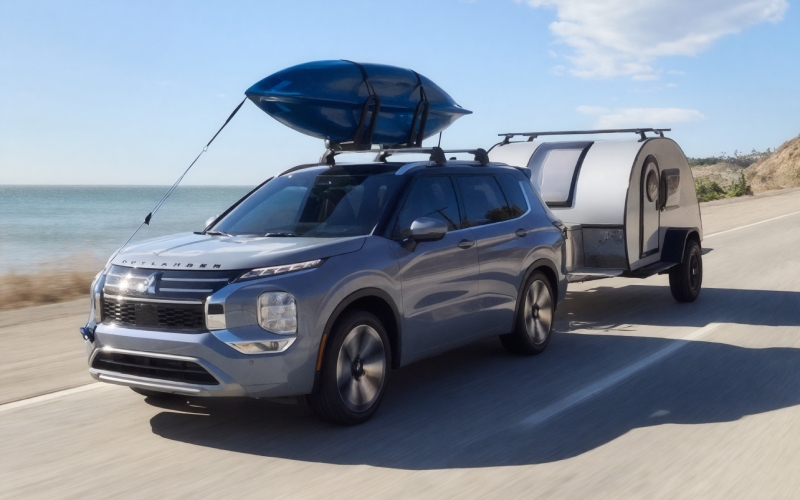
Atlantic City Mitsubishi - Which AWD system gives more everyday confidence around Glassboro, NJ — S-AWC on the 2026 Mitsubishi Outlander or AWD on the 2026 Kia Sorento?
When drivers around Glassboro, NJ compare all-wheel-drive systems in popular three-row SUVs, one question rises to the top: which setup feels more confident across an entire week’s worth of driving — not just on a snow day? Mitsubishi’s Super All-Wheel Control (S-AWC), available on the 2026 Outlander, and the available AWD with Terrain Mode on the 2026 Sorento both add valuable traction. But their tuning priorities and how they support you from school-zone crawl to highway speeds are meaningfully different.
Below, we unpack how each system works and what you’ll actually notice behind the wheel on local roads. We also share quick guidance for families juggling commuting, after-school activities, and Shore-bound weekends, so you can decide which SUV will feel most natural long after the test drive.
How S-AWC and AWD With Terrain Mode Approach Everyday Traction
S-AWC is Mitsubishi’s integrated control philosophy. It doesn’t just send power to the rear when slippage occurs; it coordinates engine output, braking, and torque distribution to support stability and cornering behavior in the moment. On the 2026 Outlander, S-AWC works with selectable drive modes — including Tarmac, Gravel, Snow, Normal, Eco, and on certain configurations Mud — so traction is aligned with your real-world surface and intent. The result is subtle but noticeable: calmer steering corrections, predictable turn-in when streets are damp, and easy starts from stop signs when sand piles up near curbs after a storm.
The 2026 Sorento’s available AWD with Terrain Mode is also confident, with settings designed for Snow and other conditions. It’s capable and gives the driver a clear menu of adjustments. Where it differs most is in the way the system interfaces with the larger vehicle dynamics. Rather than feeling like the entire chassis is working as one, it can feel more like a smart, responsive AWD layer added to a well-sorted SUV — strong in its own right, but tuned with a different emphasis.
What You’ll Notice During a Typical Week
From Glassboro’s neighborhood streets to longer drives connecting to Route 55 or the Atlantic City Expressway, here are the moments where drivers tend to prefer S-AWC’s character.
- Merging and lane changes: S-AWC’s measured torque distribution helps the Outlander hold a smooth line as you accelerate across lanes, especially on damp pavement.
- Low-speed parking maneuvers: With S-AWC and the available 360° Multi-View Camera System, gentle throttle inputs translate to predictable movement — helpful for tight lots at shopping centers or schools.
- Uneven surfaces: Gravel pull-offs, patched blacktop, or sandy shoulders are where Outlander’s Snow or Gravel mode can eliminate the “scrabble” you sometimes feel in other SUVs as they transfer power.
Beyond Traction: Technology That Reinforces Confidence
Traction is only part of feeling secure. The 2026 Outlander layers on driver assistance and clarity-increasing features that support you in the background. Available MI-PILOT Assist™ with Navi-link brings adaptive cruise with Stop & Go and lane support to ease highway stretches, while the available Dynamic Sound Yamaha® Ultimate audio with Speed and Rain Compensated Volume keeps cabin ambience steady when road noise or weather picks up. Sorento offers its own robust assistance — including available Highway Driving Assist 2 and Surround View Monitor — and families will appreciate those options as well. The difference is in the tuning: Outlander’s assistance feels cohesive and calmly integrated, complementing S-AWC’s “always-on” steadiness.
Who Should Choose Which?
If your weekly rhythm includes mixed-surface parking, wet commutes, and a lot of time at moderate speeds with family on board, the 2026 Outlander with S-AWC is the easy recommendation. It simply reduces the number of micro-corrections you make, which is the sort of advantage you only fully appreciate after a few months of ownership. If you prioritize higher tow ratings and want a more overtly rugged aesthetic with all-terrain tires on select trims, the Sorento X-Pro is a compelling direction.
Quick Decision Guide
- Primary driving mix: Mostly paved, variable weather, frequent parking — lean Outlander with S-AWC.
- Traction feel: Prefer subtle, integrated stability — Outlander’s S-AWC tuning stands out.
- Secondary needs: Higher tow rating and trail styling — consider Sorento’s X-Pro configuration.
Frequently Asked Questions:
Does S-AWC require extra maintenance compared to typical AWD?
No. S-AWC leverages components designed for long-term durability and follows the same maintenance cadence you would expect for fluids, tires, and routine inspections. Your owner’s manual outlines specifics.
Will S-AWC help on sandy or wet roads even if I don’t select a mode?
Yes. Outlander’s S-AWC is always monitoring traction and vehicle behavior. Selecting a mode refines its responses further for the surface, but the baseline tuning is already confidence-inspiring.
Is there a difference I’ll notice during longer highway drives?
Outlander pairs available MI-PILOT Assist™ with Navi-link and S-AWC’s stability to reduce fatigue over time. The steering stays calm during crosswinds and lane changes, and the driver assistance features support consistent, smooth progress.
When you are ready to compare these systems side-by-side on familiar roads, schedule a test drive with Atlantic City Mitsubishi. Our team is proud to be serving Cherry Hill, Glassboro, and Toms River with transparent guidance and a focus on what matters for everyday driving.
Request more 2026 Mitsubishi Outlander information
Categories:
Mitsubishi Outlander